
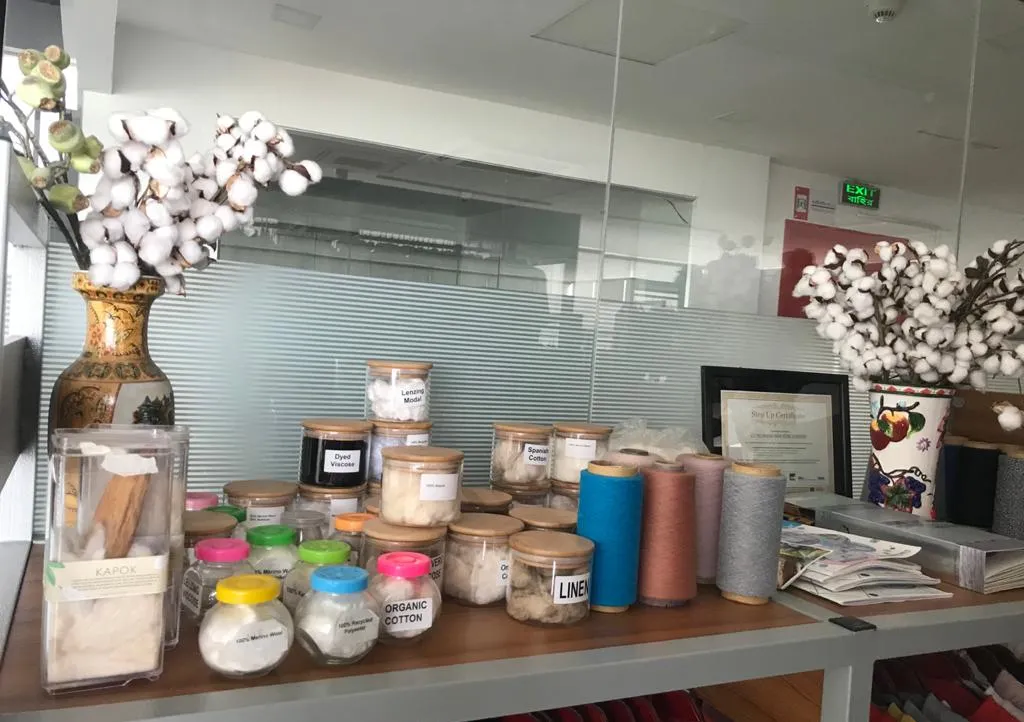
Fabrics & Materials
- Brushed / Peached Finish
- A mechanical finish in which the fabric surface is abraded with wire brushes (brushing) or fine emery rollers (peaching) to raise a soft nap. Brushing creates the plush hand of fleece and flannel, while peaching gives a subtler, suede-like touch on knits and wovens. Both finishes slightly reduce fabric strength, so they are applied within controlled limits.
- Canvas
- A heavy, tightly woven fabric, usually plain-weave cotton or a cotton blend, typically around 250-450 GSM. Its durability and stiffness make it a standard choice for tote bags, workwear, jackets, and aprons. Duck canvas is a tighter, smoother variant often used in chore coats.
- Carded Cotton
- Cotton yarn spun from fibers that have been carded (disentangled and roughly aligned) but not combed, so short fibers remain in the yarn. It is more economical than combed cotton but slightly coarser, hairier, and more prone to pilling. Carded cotton is common in basic tees and fleece where cost matters more than surface smoothness.
- Colorfastness
- A fabric's ability to retain its color when exposed to washing, rubbing (crocking), light, and perspiration. Wash and rub fastness are graded on a 1-5 gray scale, with 4-5 considered acceptable for most apparel, while light fastness is graded 1-8 on the blue wool scale. Colorfastness testing is a routine part of fabric approval and pre-shipment quality control.
- Combed Cotton
- Cotton yarn that has passed through a combing process that removes short fibers and impurities, leaving only longer, aligned fibers. The result is a smoother, stronger, less hairy yarn that resists pilling better than carded cotton. Combed cotton is the standard choice for premium t-shirts and polos. Learn more →
- Denim
- A sturdy warp-faced twill weave in which the warp yarn is dyed, traditionally with indigo, and the weft is left undyed, giving the fabric its blue face and white back. Weights typically range from around 8 oz for shirting to 14 oz or more for rigid jeans. Stretch denim adds a small percentage of elastane for comfort.
- Fleece
- A knit fabric, usually cotton, poly-cotton, or polyester, with a brushed inner surface that traps air for warmth. Apparel fleece typically runs 240-400 GSM and is the standard fabric for hoodies, sweatpants, and crewneck sweatshirts. Anti-pill finishing is common on polyester fleece. Learn more →
- French Terry
- A knit fabric with smooth face stitches and soft, unbrushed loops on the reverse side. It is lighter and more breathable than brushed fleece, typically 200-320 GSM, and is widely used for premium hoodies, joggers, and lightweight sweatshirts. Learn more →
- GSM (Grams per Square Meter)
- The standard metric for fabric weight, stating how many grams one square meter of fabric weighs. Higher GSM generally means a thicker, heavier, more durable fabric: t-shirts typically run 150-220 GSM, while hoodies and sweatshirts run around 280-450 GSM. GSM is one of the first specifications defined in a tech pack.
- Hand Feel
- The tactile quality of a fabric, covering softness, smoothness, drape, and body. Hand feel is influenced by fiber type, yarn quality, knit or weave structure, and finishing processes such as enzyme washing or silicone softeners. It is normally evaluated and approved on physical swatches before bulk production.
- Heather / Mélange
- A color effect created by blending fibers or yarns of different colors into a single yarn before knitting, producing a soft, mottled appearance rather than a solid shade. Classic heather gray typically blends cotton with a small percentage of polyester or viscose.
- Interlock
- A double-knit fabric produced by interlocking two 1x1 rib structures, creating a fabric that is smooth on both sides. Interlock is thicker, more stable, and less prone to edge curling than single jersey, which makes it popular for babywear, polos, and premium t-shirts. Learn more →
- Loopback
- Another name for French terry, referring to the unbrushed loops that back the fabric's smooth face. The looped construction absorbs moisture and breathes well, which is why loopback sweatshirts began as athletic wear. When the loops are brushed, the fabric becomes fleece. Learn more →
- Mesh
- A knit or woven fabric with an open, porous structure designed to maximize airflow. Polyester mesh is standard for sports jerseys, linings, and ventilation panels in activewear, with birdseye and micro-mesh as common variants. Weight and hole size vary widely and should be specified in the tech pack.
- Modal
- A semi-synthetic (regenerated cellulose) fiber made from beech wood pulp, known for exceptional softness, fluid drape, and resistance to shrinkage and fading. Modal is more absorbent than cotton and stays smooth after repeated washing, so it is often blended with cotton or spandex in premium tees, underwear, and loungewear. Learn more →
- Open-End (OE) Cotton
- Cotton yarn spun by the open-end (rotor) method, which twists fibers directly from a sliver without the roving stage used in ring spinning. Open-end yarn is cheaper and faster to produce but bulkier, weaker, and coarser to the touch. It is typically used in budget t-shirts, socks, and denim weft yarns.
- Organic Cotton
- Cotton grown without synthetic pesticides, herbicides, or GMO seeds, under farming standards designed to protect soil and water. For a garment to be sold as organic, the supply chain is typically certified to GOTS, which tracks the fiber from farm to finished product. Learn more →
- Pilling
- The formation of small balls of tangled fiber on a fabric's surface, caused by abrasion during wear and washing. Short, loosely twisted fibers pill the most; combed ring-spun cotton and tightly constructed fabrics resist it better. Pilling resistance is tested by machine and graded on a 1-5 scale.
- Pique
- A knit fabric with a textured, waffle-like surface created by a raised geometric stitch pattern, best known as the classic polo shirt fabric. Cotton pique typically runs 180-260 GSM, breathes well, and hides minor wrinkles better than flat jersey. Learn more →
- Poly-Cotton (TC / CVC)
- A blended fabric combining polyester and cotton fibers. TC is polyester-rich (commonly 65% polyester, 35% cotton) and prized for durability and low cost, while CVC ('chief value cotton') is cotton-rich (commonly 60% cotton, 40% polyester) and feels closer to pure cotton. Blends shrink less, dry faster, and wrinkle less than 100% cotton.
- Poplin
- A tightly woven plain-weave fabric with very fine horizontal ribs, usually cotton or poly-cotton, typically around 100-140 GSM. Its smooth, crisp surface makes it the standard fabric for dress shirts, and it takes printing well for casual button-ups.
- Recycled Polyester (rPET)
- Polyester fiber produced from recycled material, most commonly post-consumer PET bottles that are cleaned, flaked, melted, and re-extruded into yarn. rPET performs essentially the same as virgin polyester while reducing reliance on new petroleum. Recycled content claims are typically verified through GRS (Global Recycled Standard) certification. Learn more →
- Rib Knit (1x1 / 2x2)
- A knit structure with vertical ridges formed by alternating knit and purl stitch columns: 1x1 rib alternates every stitch, while 2x2 alternates every two. Rib knit stretches significantly in width and recovers well, making it the standard fabric for neckbands, cuffs, hems, and fitted tanks. Learn more →
- Ring-Spun Cotton
- Cotton yarn produced on a ring-spinning frame, which continuously twists and thins the fibers into a fine, strong, smooth yarn. Ring-spun cotton feels noticeably softer than open-end cotton and is the default choice for retail-quality t-shirts. Combed ring-spun is the premium grade.
- Sanforized / Compacted
- Pre-shrinking treatments that mechanically force a fabric into its relaxed dimensions before cutting. Sanforization is applied to woven fabrics such as denim and poplin and typically brings residual shrinkage down to around 1%, while compacting is the knit equivalent and typically holds shrinkage to around 5% or less. Skipping this step is a common cause of garments shrinking a full size after the first wash.
- Shrinkage
- The percentage a fabric contracts in length and width after washing and drying, measured against marked dimensions on a test specimen. Untreated cotton knits can shrink 5-10%, while compacted knits typically hold to around 5% or less and sanforized wovens to around 1%. Acceptable shrinkage tolerances should be written into the tech pack and verified before bulk production.
- Single Jersey
- The most common knit fabric for t-shirts, made on a single set of needles so the face shows flat V-shaped stitches and the back shows loops. It is light, stretchy, and economical, typically 140-200 GSM for tees, though its edges curl and it is less dimensionally stable than double knits. Learn more →
- Slub
- A yarn or fabric with intentional irregular thick-and-thin sections that create a subtly textured, organic-looking surface. Slub jersey is popular for fashion tees and layering pieces because the texture adds visual interest without printing. The effect is created during spinning by varying the yarn's twist and thickness.
- Spandex (Elastane / Lycra)
- A synthetic elastic fiber that can stretch several times its length and recover its shape; elastane is the generic name in Europe, spandex in North America, and Lycra is a brand name. Blending even 3-10% spandex into cotton or polyester adds significant stretch and recovery, which is why it appears in leggings, fitted tees, and swimwear. Learn more →
- Tencel (Lyocell)
- Lyocell is a regenerated cellulose fiber made from wood pulp in a closed-loop solvent process that recovers nearly all of the solvent; Tencel is the best-known brand, produced by Lenzing. The fiber is smooth, strong, breathable, and biodegradable, with excellent moisture management, and is used in premium tees, dresses, and denim blends. Learn more →
- Twill
- A weave pattern that produces diagonal ribs on the fabric face by offsetting each weft yarn over and under multiple warp yarns. Twill fabrics such as denim, chino, and gabardine are durable, drape well, and hide soil and wrinkles better than plain weaves.
- Yarn Count (Ne)
- A measure of yarn fineness in the English cotton count system, defined as the number of 840-yard hanks per pound. Higher Ne numbers mean finer yarn: 20s and 24s knit heavier, coarser fabrics, while 30s and 40s produce lighter, smoother jerseys. Notation such as 30/1 means single-ply 30s yarn.
Manufacturing & Production
- AQL 2.5 (Acceptable Quality Limit)
- A statistical inspection standard, based on ISO 2859-1, that defines the maximum percentage of defective units allowed in a random sample before a production batch is rejected. AQL 2.5 is the most common level for general apparel, meaning no more than 2.5 percent major defects in the sampled units, usually paired with a looser 4.0 limit for minor defects. Essential Group inspects finished orders to AQL 2.5 before shipment. Learn more →
- Bartack
- A dense cluster of zigzag stitches sewn back and forth over a small area to reinforce high-stress points such as pocket corners, belt loops, fly zippers, and strap attachments. Bartacks prevent seams from breaking under repeated strain and are a standard durability detail on jeans, workwear, and bags.
- Bill of Materials (BOM)
- An itemized list of every material needed to produce one garment, including fabric, thread, zippers, buttons, labels, hangtags, and packaging, with quantities, colors, sizes, and supplier references for each. The BOM is a core section of a tech pack and drives costing, material purchasing, and production planning.
- Bulk Production
- The main manufacturing stage in which the full order quantity is cut, sewn, finished, inspected, and packed after all samples are approved. Bulk production starts only once the pre-production sample is signed off and fabrics and trims are in-house, and it typically takes 30 to 60 days depending on quantity and complexity. Learn more →
- CMT (Cut, Make, Trim)
- A manufacturing arrangement in which the buyer supplies the fabric, trims, and technical specifications, and the factory charges only for cutting, sewing, and finishing. CMT gives buyers a lower factory price and direct control over materials, but they carry the risk and workload of sourcing, shipping, and quality-checking every input themselves.
- Coverstitch
- A stitch made with two or more needle threads and a looper thread, producing parallel rows of stitching on the face and a flat, stretchable network of thread on the reverse. It is the standard hem finish on T-shirts, leggings, and other knit garments because it stretches with the fabric without popping.
- Cut and Sew
- A production method in which garments are manufactured from scratch: fabric is cut into pattern pieces and sewn into finished products, rather than decorating pre-made blank garments. Cut and sew gives a brand full control over fit, fabric, construction, and labeling, and is the standard approach for private label clothing. Learn more →
- Fabric Spreading (Lay)
- The process of unrolling fabric onto a cutting table in smooth, aligned layers to form a stack called a lay, ready for cutting. Even tension and precise edge alignment during spreading are critical, because stretched or skewed layers produce distorted pattern pieces and sizing defects in the finished garments.
- Final Inspection
- A quality audit carried out when an order is finished and at least 80 percent packed, in which garments are randomly sampled and checked for defects, measurements, labeling, and packing against the approved sample and an AQL standard. It is the last quality gate before goods are released for shipment.
- Findings
- A traditional garment-trade term for the small functional components of a garment other than fabric, such as buttons, zippers, snaps, hooks, and elastic. In modern usage findings overlaps heavily with trims, though findings usually implies functional hardware while trims can also include decorative elements.
- Fit Sample
- A sample garment sewn specifically to evaluate fit on a live model or dress form, usually in the base size and in the correct or a comparable fabric. Fit comments are recorded against the measurement chart, and revised rounds are made until fit is approved, after which the pattern is locked and graded into the size range. Learn more →
- Flatlock Stitch
- A seam type in which two fabric edges are butted together and joined with interlocking thread, producing a seam that lies completely flat with no ridge on either side. Flatlock construction reduces bulk and chafing, which makes it common in activewear, base layers, and underwear.
- FOB vs. Full Package Production (FPP)
- Two ways of buying garments from a factory. Under FOB (Free on Board), the factory sources materials and manufactures the goods, with the price covering everything up to loading at the export port; under full package production, the factory additionally manages development, sampling, sourcing, quality control, and packing as a single accountable partner. FPP suits brands without their own sourcing teams, while FOB and CMT give experienced buyers more direct control. Learn more →
- Grading (Pattern Grading)
- The process of scaling an approved base-size pattern into the full size range using grading rules, the predefined increments that specify how much each point of measure grows or shrinks between sizes (for example, around 5 cm per size at the chest). Accurate grading preserves fit and proportion across sizes; incorrect grading rules are a leading cause of size-specific fit complaints.
- Inline Inspection
- A quality check performed on the sewing line while production is in progress, typically on the first output of each operation and at set intervals afterward. Catching problems inline lets the factory correct machine settings, handling, or technique before defects spread across large quantities, which is far cheaper than reworking finished goods.
- Lead Time
- The total time from order confirmation to goods ready for shipment, covering fabric procurement, cutting, sewing, finishing, and final inspection. Apparel production lead times typically run 30 to 90 days depending on order size, fabric availability, and customization, with sampling and transit adding time before and after. Learn more →
- Marker Making
- The process of arranging all pattern pieces for an order's sizes into a cutting layout, called a marker, usually optimized with CAD software. Marker efficiency measures how much of the fabric width is actually used; because fabric is typically the largest cost in a garment, even a small improvement in marker efficiency meaningfully reduces unit cost.
- MOQ (Minimum Order Quantity)
- The smallest number of units a manufacturer will accept for one order, usually counted per style and often with sub-minimums per color or size. MOQs exist because fabric mills, dyeing, and production line setup carry fixed costs; at full-package factories such as Essential Group, MOQ typically starts around 50 pieces per style. Learn more →
- Overlock Stitch (Serging)
- A stitch formed by an overlock machine, also called a serger, which trims the raw fabric edge and wraps it in thread while sewing the seam in a single pass. Three- and four-thread overlock seams are the standard construction for knitwear such as T-shirts and hoodies because they stretch and stop fraying.
- Pattern Making
- The drafting of flat templates, called patterns, that define the exact shape of every fabric piece in a garment, translating a sketch and measurement spec into cuttable geometry. Pattern making determines fit and silhouette; patterns are refined through sampling and then graded into the full size range. Learn more →
- Pre-Production Sample (PP Sample)
- The final sample made before bulk manufacturing, sewn with the actual production fabric, trims, colors, prints, and labels. The approved PP sample is the binding quality reference for the entire order, and bulk cutting should not begin until it is signed off.
- Production Run
- One continuous manufacturing cycle for a specific style and order, from cutting through sewing, finishing, and packing. Run size affects unit cost because fixed setup work, such as marker making, machine threading, and line balancing, is spread across the quantity produced.
- Proto Sample
- The first physical sample of a new design, made to test the concept, construction, and overall shape, often in a substitute fabric or whatever color is available. Proto samples are expected to need changes; their job is to expose design and construction problems early, before money is spent on exact materials. Learn more →
- Quality Control (QC)
- The system of checks that ensures garments meet the buyer's specification, spanning incoming fabric inspection, inline checks during sewing, measurement audits, and final inspection against an AQL standard. Effective QC catches defects at the earliest stage possible, where they are cheapest to correct. Learn more →
- Salesman Sample (SMS)
- A small quantity of near-final-quality samples produced before bulk manufacturing for showrooms, trade shows, buyer meetings, lookbooks, and pre-order campaigns. Salesman samples are usually made across key sizes and colorways so a brand can sell the collection before committing to full production.
- Seam Allowance
- The margin of fabric between the stitch line and the raw edge of a pattern piece, commonly 1 to 1.5 centimeters in apparel depending on seam type. Seam allowances are built into the pattern; too little causes seams to pull apart in wear, while too much adds bulk and wastes fabric.
- Sewing Line
- A production layout in which machines and operators are arranged in sequence, each performing one operation as garments move down the line in bundles or single pieces. Balancing the line, assigning operations so no workstation becomes a bottleneck, is what determines its daily output and efficiency.
- Size Set
- A round of samples covering the full size range of a style, or at minimum the smallest, base, and largest sizes, made to verify that grading delivers correct fit in every size. Size set approval usually sits between fit approval and the pre-production sample.
- Stitch Density (SPI)
- The number of stitches per inch in a seam, a primary indicator of sewing quality. Most apparel seams are sewn at around 8 to 12 SPI; higher density gives stronger, neater seams but slows sewing, while low SPI can cause seam grinning, puckering, and premature failure.
- Tech Pack
- A technical specification document that tells a factory exactly how to manufacture a garment, typically including flat sketches, a measurement chart with tolerances, a bill of materials, construction and stitch details, artwork placements, and labeling and packing instructions. A complete tech pack shortens sampling, prevents costly misinterpretation, and enables accurate quotes. Learn more →
- TOP Sample (Top of Production)
- A sample pulled from the first finished units of an actual production run and sent to the buyer to confirm that bulk quality matches the approved pre-production sample. Because TOP samples reflect real line output rather than sample-room work, many buyers require TOP approval before shipment.
- Trims
- All the materials attached to a garment besides the main fabric, including zippers, buttons, drawcords, elastics, interlinings, labels, and decorative details. Trims are specified in the bill of materials and must be approved and delivered to the factory before bulk production can begin.
Printing, Embroidery & Branding
- 3D Puff Embroidery
- An embroidery technique where satin stitches are sewn over a foam underlay, typically 2-3 mm thick, to create a raised, three-dimensional surface. It is most common on caps and heavier fabrics and works best with bold shapes and lettering rather than fine detail.
- All-Over Print (AOP)
- A print that covers the entire garment, including across seams, rather than a single placed graphic. It is achieved either by printing the fabric before cutting and sewing (cut-and-sew AOP, usually via sublimation or rotary printing) or by oversized-platen printing on finished garments; cut-and-sew AOP gives the most complete coverage. Learn more →
- Appliqué
- A decoration technique where a piece of fabric is cut to shape and sewn onto the garment, usually finished with a satin or zigzag embroidery border. Common on varsity jackets, hoodies, and kidswear, it adds texture while using far fewer stitches than filling the same area with embroidery alone.
- Care Label
- The label stating fiber content, country of origin, and washing instructions, usually sewn into the side seam or below the neck label. Care labels are a legal requirement in most markets, including FTC rules in the US and EU labeling regulations, and must accurately reflect the actual fabric used.
- Chenille Embroidery (Toweling Embroidery)
- A looped-yarn embroidery technique that produces a soft, raised, towel-like texture, best known from varsity letterman patches. Chenille is worked with thick yarns on specialized machines and is usually produced as a patch that is then sewn or heat-sealed onto the garment.
- Color Matching
- The process of matching printed or dyed colors to a target standard, usually a Pantone reference, before bulk production. Lab dips (for fabric dyeing) and strike-offs or press proofs (for printing) are submitted for buyer approval, and results are judged against agreed tolerances because exact matches vary by fabric and ink system. Learn more →
- Custom Packaging
- Branded packaging produced as part of a clothing order, such as printed poly bags, tissue paper, stickers, boxes, or mailers. Full-package manufacturers such as Essential Group handle packaging in-house, so garments arrive folded, bagged, and labeled to the brand's specification. Learn more →
- Digitizing (Embroidery Digitizing)
- Converting artwork into a machine-readable embroidery file that defines stitch types, directions, densities, and sewing sequence. Digitizing quality largely determines how clean the finished embroidery looks; the same logo digitized by different operators can vary noticeably in sharpness and texture.
- Discharge Printing
- A screen printing method that uses a discharge agent to remove the garment's dye and replace it with pigment, allowing light colors on dark fabric with a very soft hand feel. It works reliably only on 100% cotton dyed with dischargeable (typically reactive) dyes, so fabric and dye compatibility must be confirmed before production. Learn more →
- DTF (Direct-to-Film) Printing
- A digital printing method where designs are printed onto PET film, coated with hot-melt adhesive powder, and then heat-pressed onto the garment. DTF reproduces full-color artwork with no per-design setup and adheres to cotton, polyester, and blends, making it popular for small runs and orders with many designs. Learn more →
- DTG (Direct-to-Garment) Printing
- Inkjet printing of water-based inks directly onto a finished garment, comparable to a paper printer working on fabric. DTG handles photographic detail and unlimited colors with no screen setup, making it cost-effective for samples and small runs; it performs best on high-cotton fabrics and requires pretreatment on dark colors. Learn more →
- Flat Embroidery
- Standard machine embroidery where the thread sits flat against the fabric, used for logos, monograms, and text. It is durable and premium-looking, with cost driven mainly by stitch count; fine gradients and very small text generally reproduce better in print than in embroidery. Learn more →
- Halftone
- A printing technique that simulates gradients and shading using patterns of small dots of varying size or spacing. In screen printing, halftones let a single ink color reproduce tonal artwork; dot frequency is specified in LPI (lines per inch) and must be matched to the screen mesh count.
- Hang Tag
- The printed cardstock tag attached to a garment, typically with a plastic barb or string, carrying branding, product information, or pricing. Hang tags are part of the retail presentation and are normally specified alongside labels and packaging in the tech pack.
- Heat Transfer
- A decoration applied by printing a design onto a carrier film or paper and bonding it to fabric with a heat press using controlled time, temperature, and pressure. The term covers several technologies, including DTF, heat transfer vinyl (HTV), sublimation transfers, and plastisol transfers, each with different durability and hand feel.
- High-Density Print
- A screen printing effect that builds thick, sharply raised layers of plastisol ink with crisp vertical edges, creating a rubbery, embossed look. It is produced with thick stencils and multiple print passes and is widely used for streetwear logos.
- Neck Label
- The brand label at the interior back neck of a garment, either sewn in as a woven or printed label or applied as a tagless heat transfer. Replacing a blank garment's original neck label with the brand's own, known as relabeling, is a defining step in private label manufacturing. Learn more →
- Pantone Matching System (PMS)
- A standardized color system used to specify exact colors across suppliers, so a code such as PMS 186 C refers to the same red in any factory. Tech packs should reference Pantone codes (TPG/TPX for dyed fabric, C/U for print) rather than on-screen RGB values, which are not reliable production references. Learn more →
- Patch (Woven, Embroidered, PVC)
- A separately produced emblem attached to a garment by sewing, heat sealing, or hook-and-loop backing. Woven patches hold fine detail, embroidered patches give a classic textured look, and PVC (rubber) patches offer a molded, waterproof 3D finish common on outdoor and workwear styles.
- Pigment Printing
- Printing with insoluble pigment particles fixed to the fabric surface with a binder, rather than dyes that chemically bond into the fiber. Pigment systems work on almost any fiber and form the basis of most water-based textile printing; hand feel and wash durability depend on the binder and curing process.
- Plastisol Ink
- The most common screen printing ink, made of PVC particles suspended in plasticizer that cure into a durable film at around 320°F (160°C). Plastisol delivers opaque, vibrant color on dark fabrics and consistent results in bulk, but it sits on top of the fabric with a heavier hand feel than water-based ink.
- Poly Bag
- The clear or frosted polyethylene bag that protects each folded garment during shipping, usually printed with a suffocation warning and often carrying a size sticker. Bag dimensions, thickness, and stickering are typically specified by the buyer or retailer, and recycled-content or biodegradable options are widely available.
- Printed Label (Satin Label)
- A label made by printing brand and care information onto satin, cotton, or nylon tape rather than weaving it. Printed labels are cheaper and faster to produce than woven labels and suit fine print such as multi-language care text, but they are less durable over repeated washing.
- Puff Print
- A screen printing effect that uses a foaming additive in plastisol ink so the print expands during heat curing, creating a soft, raised 3D surface. It suits bold shapes and lettering; fine lines and small details lose definition as the ink expands.
- Retail-Ready Packaging
- Packing garments so they can go directly to a store shelf or fulfillment center without repacking: correct folding, poly bags, size stickers, barcodes, hang tags, and carton markings to the retailer's specification. Requirements should be confirmed before production, since retailers and 3PLs, including Amazon FBA, each enforce their own compliance rules. Learn more →
- Screen Printing
- The dominant garment printing method, in which ink is pushed through a mesh stencil onto fabric using one screen per color. It offers strong durability and the lowest cost per piece at volume, with vibrant results on both light and dark garments; because each color requires screen setup, it typically suits runs of around 50 or more pieces per design. Learn more →
- Stitch Count
- The total number of stitches in an embroidery design, and the main driver of embroidery cost and machine run time. A simple left-chest logo typically runs about 4,000-8,000 stitches; larger or denser designs cost more and can stiffen lightweight fabrics.
- Sublimation Printing
- A digital method where dye printed on transfer paper turns to gas under heat and bonds inside polyester fibers, producing prints with no hand feel that do not crack or peel. It requires white or light-colored polyester or high-polyester blends and does not work on cotton, which makes it the standard for all-over prints and performance wear. Learn more →
- Tagless Print Label
- Brand and size information heat-transferred or screen printed directly onto the inside of a garment instead of a sewn-in label. Tagless labels eliminate neck irritation and are standard on underwear, activewear, and many premium basics; durability depends on transfer quality and the fabric.
- Underbase
- A first layer of ink, usually white, printed beneath the design when screen printing on dark garments so the top colors appear bright and accurate. A flash-cured underbase adds one screen and slightly more hand feel to the job, which is why printing on dark garments typically costs more than on light ones.
- Water-Based Ink
- Screen printing ink that uses water as the carrier and soaks into the fabric, giving a soft, breathable print with almost no hand feel. It is favored for premium and vintage-style garments, but it is less opaque than plastisol on dark fabrics unless combined with a discharge system.
- Woven Label
- A label created by weaving colored threads on a loom, most often in damask for fine detail, then folded and sewn into the garment. Woven labels are the standard choice for brand neck labels because they are durable, colorfast, and perceived as higher quality than printed labels. Learn more →
Business, Pricing & Logistics
- Air Freight
- Transporting cargo by aircraft, the fastest standard shipping method for apparel orders. From Bangladesh to the US or Europe, air freight typically takes 5 to 10 days door to door and costs several times more per kilogram than sea freight, making it best suited to smaller, time-sensitive, or high-value shipments.
- AWB (Air Waybill)
- The transport document an airline or freight forwarder issues for air cargo, serving as a receipt for the goods and evidence of the contract of carriage. Unlike an ocean bill of lading, an air waybill is not a document of title, so the named consignee can collect the shipment without presenting an original.
- Bill of Lading (B/L)
- A document issued by an ocean carrier that serves three functions: receipt for the shipped goods, evidence of the contract of carriage, and document of title. The consignee generally needs the original bill of lading, or a telex release, to claim a sea freight shipment at the destination port.
- CIF (Cost, Insurance and Freight)
- An Incoterm for sea freight under which the seller pays for ocean transport and minimum insurance cover to the named destination port, while risk transfers to the buyer once the goods are loaded at origin. The buyer remains responsible for import clearance, duties, and delivery from the port.
- Commercial Invoice
- The official invoice issued for an export shipment, listing seller, buyer, goods description, quantities, unit prices, HS codes, and the agreed Incoterm. Customs authorities use the commercial invoice to determine the shipment's value and assess import duties, so it must reflect the actual transaction.
- Customs Clearance
- The process of declaring imported goods to a country's customs authority, presenting documents such as the commercial invoice, packing list, and transport document, and paying any duties and taxes due. Goods are released for final delivery only after clearance, which is usually handled by a customs broker, freight forwarder, or courier.
- DAP (Delivered at Place) / DDU
- An Incoterm under which the seller pays for transport to the buyer's named destination, but the buyer handles import clearance and pays duties and taxes on arrival. DAP replaced DDU (Delivered Duty Unpaid) in Incoterms 2010, and the two terms are used interchangeably in everyday sourcing.
- DDP (Delivered Duty Paid)
- An Incoterm under which the seller manages the entire shipment, including export clearance, international freight, import clearance, and all duties and taxes, delivering to the buyer's address at one all-inclusive price. DDP removes surprise charges on arrival, which makes it the simplest option for new brands; full-package manufacturers such as Essential Group ship DDP worldwide. Learn more →
- De Minimis
- A value threshold below which imported goods can enter a country without paying duties or filing a formal customs entry. Thresholds differ by country and have shifted with recent trade policy changes, so brands should verify the current rule in each destination market before pricing small direct-to-consumer shipments.
- Express Courier (DHL, FedEx, UPS)
- Door-to-door international parcel shipping through integrated carriers such as DHL, FedEx, and UPS, typically delivering from Bangladesh to the US or Europe in 3 to 7 days. Couriers clear customs in transit and charge by dimensional weight, which makes them the default method for samples and small production runs despite higher per-kilogram rates.
- EXW (Ex Works)
- An Incoterm under which the manufacturer simply makes goods available at its own premises, and the buyer arranges and pays for everything from the factory gate onward, including export clearance, freight, and import formalities. EXW produces the lowest quoted unit price but transfers maximum cost, risk, and paperwork to the buyer.
- FCL vs. LCL (Full / Less than Container Load)
- FCL (Full Container Load) means booking an entire ocean container for one shipment, while LCL (Less than Container Load) means sharing container space with other shippers and paying by cargo volume. LCL suits smaller apparel orders, but FCL reduces handling and usually becomes cheaper per unit once a shipment approaches roughly 13 to 15 cubic meters.
- FOB (Free on Board)
- An Incoterm for sea freight under which the seller delivers goods loaded on board the vessel at the origin port with export clearance completed; cost and risk pass to the buyer at that point. FOB is the most common quoting basis in garment manufacturing, with the buyer's freight forwarder managing the onward journey.
- Freight Forwarder
- A logistics company that organizes international shipments on behalf of cargo owners, booking carrier space, preparing shipping documents, and coordinating customs clearance. Because forwarders consolidate volume from many clients, they typically secure better freight rates than a small brand could obtain directly from carriers.
- HS Code (Harmonized System Code)
- A standardized numerical classification for traded products, maintained by the World Customs Organization and used by customs authorities to set duty rates. The first six digits are harmonized globally, and most garments fall under chapter 61 (knitted apparel) or chapter 62 (woven apparel); the code declared on the commercial invoice determines the duty a shipment pays.
- Import Duty (Tariff)
- A tax a government levies on imported goods, usually calculated as a percentage of the declared customs value and determined by the product's HS code and country of origin. Apparel duty rates vary significantly by market and fiber content, and preferential trade programs can reduce or eliminate duties for qualifying origins.
- Incoterms
- Standardized international trade terms published by the International Chamber of Commerce that define exactly where the seller's responsibility for costs, risk, and customs formalities ends and the buyer's begins. The Incoterms most used in apparel sourcing are EXW, FOB, CIF, DAP, and DDP; the same unit price can mean very different landed costs depending on the term.
- Landed Cost
- The complete cost of getting a product to its final destination: factory price plus freight, insurance, import duties and taxes, brokerage, and last-mile delivery. Comparing suppliers on landed cost rather than unit price alone is essential, because a lower FOB quote can be erased by higher freight and duty charges. Learn more →
- LDP (Landed Duty Paid)
- A commercial term, widely used in US apparel sourcing, meaning the seller delivers goods with freight, customs clearance, and import duties all paid, functionally similar to the Incoterm DDP. Under LDP the buyer receives finished goods at an all-inclusive price, typically at a nominated warehouse or distribution point.
- Letter of Credit (L/C)
- A bank-issued payment guarantee that pays the manufacturer once it presents documents proving shipment according to the agreed terms. An L/C shifts payment risk from the buyer to the issuing bank, which suits large orders, but bank fees and strict document requirements make it less common for small first production runs than T/T payment.
- Markup vs. Margin
- Markup expresses profit as a percentage of cost, while margin expresses profit as a percentage of selling price. A garment costing $10 and sold at $25 carries a 150% markup but a 60% margin; mixing up the two is one of the most common pricing errors when planning a clothing line. Learn more →
- ODM (Original Design Manufacturer)
- A manufacturer that develops its own product designs, which buyers can select, lightly modify, and sell under their own brand. ODM shortens development time and reduces cost because patterns, samples, and fabrics already exist, but it offers less exclusivity than OEM production from original designs. Learn more →
- OEM (Original Equipment Manufacturer)
- A manufacturer that produces garments to the buyer's own designs and specifications, usually working from a tech pack, with the brand retaining ownership of the design. OEM is the standard model for brands that want full control over fit, fabric, and construction. Learn more →
- Private Label
- A model in which a factory manufactures garments that are sold under the buyer's brand name rather than the manufacturer's. Private label covers both OEM (your original designs) and ODM (factory designs rebranded), letting a brand own its customer relationships and pricing without owning a factory. Learn more →
- Proforma Invoice (PI)
- A preliminary invoice issued before production that confirms the products, quantities, unit prices, payment terms, and delivery terms of a proposed order. The buyer approves the proforma invoice and pays the deposit against it; the commercial invoice later replaces it when the goods ship. Learn more →
- Purchase Order (PO)
- A buyer's formal commitment to purchase specified products at agreed prices, quantities, and delivery dates. In garment manufacturing, the PO combined with the approved pre-production sample and tech pack defines exactly what the factory is contractually obligated to deliver. Learn more →
- Sample Fee
- A charge for developing and sewing pre-production samples, covering pattern making, materials, and skilled labor outside the normal production line. Sample fees typically run from about $30 to $150 per style depending on complexity, and many manufacturers credit the fee back against a confirmed bulk order. Learn more →
- Sea Freight
- Transporting cargo by ocean container vessel, the most economical shipping method for bulk apparel orders. Transit from Chattogram, Bangladesh to the US or Europe typically takes 25 to 40 days port to port, so sea shipments need to be planned into the production calendar well in advance.
- T/T Payment (Telegraphic Transfer)
- An international bank wire transfer and the most common way garment orders are paid. Terms are typically split into a deposit (often 30 to 50%) that starts production and a balance paid before shipment or against shipping documents, a structure that funds the factory's fabric purchase while protecting the buyer until goods are ready.
- Third-Party Inspection
- A quality audit performed at the factory by an independent inspection company hired by the buyer, most often on finished goods before shipment. Inspectors draw a statistical sample, commonly to the AQL 2.5 standard, and issue a pass/fail report that verifies quality independently of the factory's own QC. Learn more →
- White Label
- A model in which a manufacturer produces a generic, ready-designed product that multiple brands can buy and sell under their own labels with minimal customization. White label is the fastest, lowest-cost route to market but offers little differentiation compared with private label production customized to one brand. Learn more →
- Wholesale Price
- The price at which a brand sells products in bulk to retailers, conventionally set around 2 to 2.5 times the landed cost, with retail prices then typically 2 to 2.5 times wholesale. Working backward from a target retail price through wholesale determines the maximum landed cost a garment can carry and still be profitable. Learn more →
Ready to turn the jargon into a real product?
We manufacture from 50 pcs per style with DDP shipping worldwide — and walk you through every step.
Request a Quote